Wild Water
March 14, 2028 · Portland, Oregon · 6:54 a.m.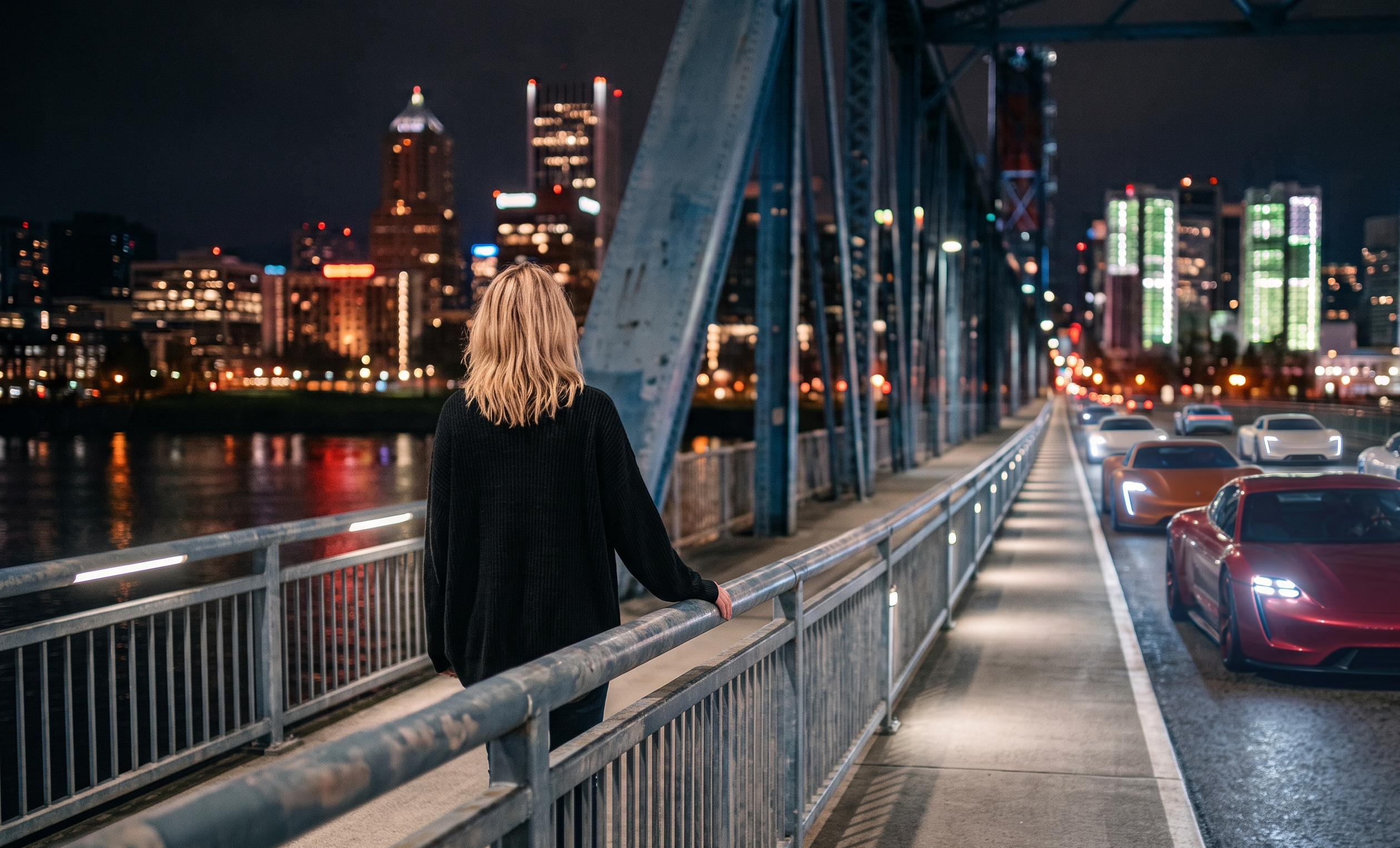
The night had started, as Sabrina's best nights always did, with absolutely no plan whatsoever. Dex's place had turned into a group thing, which had turned into someone saying let's go to Solstice, which was the bar on Burnside that Kira refused to attend on principle because it was too loud and too self-consciously future-forward, but which Sabrina loved for exactly those reasons. They had arrived at ten-thirty. By eleven, Sabrina had ordered her second Zero-G cocktail, set her BAC threshold to a comfortable 0.06 on the bar's app — I have things to do in the morning — and was feeling, by any reasonable measure, excellent.
This was before Callum.
Before the silence between songs.
Before everything.
Solstice was a particular kind of beautiful on a Thursday night. The walls were smart composite — biometric mood surfaces that read the room's aggregate emotional state and shifted the lighting in response. Not intrusively, not obviously — more like good theatrical lighting: you felt it before you noticed it. Tonight the room was running warm amber with threads of deep violet, which meant the collective biometric of everyone present was reading as relaxed, socially open, mildly elevated. Accurate. The bar was full and easy and alive.
Above the dance floor, what looked like a cluster of mirror-ball fragments hung from the ceiling — each one a precision laser-audio emitter that tracked individual patrons via their wristband and projected a focused beam of sound so directional that each person in the room was technically hearing their own music. The couple near the speaker column: something with a driving bassline, judging by the way they moved. The group at the high-top: something slower, heads nodding in a different rhythm entirely. Sabrina was hearing a playlist she'd synced on arrival — warm, percussive, exactly right.
You could share. That was the part she loved. Catch someone's eye, point at them, touch your ear — and the system synced your streams. Instant intimacy with a stranger. She had done it twice already tonight. Both times the person had looked surprised, then smiled.
Coverage: up to 340 simultaneous individual streams per venue
Sharing: point-and-pull gesture · syncs two streams instantly
Isolation: zero bleed between beams at standard distances
The bar itself was staffed by two humans and one Optimus Series 4 — the Tesla unit that Solstice had deployed six months ago and that still made people do a double-take on their first visit. The synthetic skin was the achievement: thermally accurate, micro-textured to match human dermal variation at close range. Sabrina had stood two feet away on her first visit and genuinely not been certain. The eyes were the tell if you knew to look — a fraction too steady, the blink calibrated rather than involuntary.
She had mentioned this to Dex last week and Dex had pulled up the promo for Series 5, due next year. Two people shown — a man in a kitchen, a woman at a desk. They had watched it three times trying to identify which was the robot.
They couldn't.
Neither of them had said anything for a moment after that.
Series 5 preview: zero-failure identification in standard lighting · available 2029
Note: The staff named the unit Marcus. Nobody asked the unit its preference. Nobody had thought to yet.
As for the drinks — Solstice carried both. Traditional menu on the left side of the screen: your standard ethanol offerings, same as they'd always been, same consequences in the morning, same risk of the specific 3 a.m. cortisol spike of regret that Sabrina had decided, at twenty-three, she was too old for. On the right: the Zero-G line. Precision-fermented molecular analogs that tasted like the ideal version of whatever you ordered — cleaner, more itself, without the rough edges of traditional brewing — and came with the feature that had changed nightlife entirely: a user-set BAC ceiling. You told the app exactly where you wanted to land. The drink's molecular design honored that threshold precisely. You felt the warmth, the ease, the loosening of the social self. What you did not feel was the lurch past the point of good judgment.
No hangover. No regret. Just exactly the experience you chose.
Sabrina had chosen 0.06.
What she had not accounted for — what the app's onboarding tutorial mentioned in paragraph four of the terms and conditions that nobody read — was that the precision fermentation process produced a significantly higher carbonation profile than traditional brewing. Particularly in the pale ale variants. Particularly on an empty stomach.
She had not eaten since lunch.
Hangover compounds: zero acetaldehyde · zero inflammatory response · zero next-day effect
Traditional alcohol: still available · still your choice · still exactly what it always was
Carbonation profile: significantly elevated vs traditional brewing · see terms and conditions · paragraph four
His name was Callum. He had been at the end of the bar when she arrived, leaning against the counter with the specific ease of someone who had decided early in life that confidence was simply a posture you adopted until it became a fact. Dark hair. A jawline that did what jawlines occasionally did to Sabrina when she was two Zero-G drinks in, which was to temporarily impair her judgment about whether she was being obvious.
She was being obvious.
He knew it. He was letting her get away with it anyway, which was somehow worse.
They had been talking for twenty minutes — not the effortful kind, where you're aware of every word before it leaves your mouth, but the good kind, where the conversation had its own momentum and you were just trying to keep up. He was a structural engineer. He'd worked on three of the mycelium-print buildings going up in the Pearl District. He talked about them the way people talked about things they were genuinely proud of — not performing pride, actually feeling it — and Sabrina, who had been known to cry on bridges, found this extremely attractive and was doing a poor job of hiding it.
"The thing people don't understand," he said, swirling his drink — traditional IPA, she noticed, old school — "is that you're not building a structure. You're growing one. The geometry has to account for the fact that the material is alive and will keep changing. You can't just design it and walk away."
"So it's more like — gardening?" Sabrina said. Which was not the sophisticated response she had intended.
He looked at her. One corner of his mouth. "Yeah," he said. "Exactly like gardening. Except the garden is twelve stories tall and holds four hundred people."
She laughed. Genuinely. And he smiled — not the polite kind, the real kind — and she thought: okay. This is actually going well.
He was mid-sentence — something about load-bearing fungal lattices, which should not have been interesting but was, coming from him, in that voice, with that jawline — when Sabrina felt it.
A pressure. Rising. Insistent.
Her body's entirely reasonable request, given two Zero-G pale ales on an empty stomach, to release some of the carbonation that had been accumulating for the past forty minutes.
She overrode it. Socially. Firmly. The way you did.
The way you absolutely should not do.
Because the body, when overridden, does not simply abandon the request.
It reroutes it.
The laser audio array chose this exact moment — mid-reroute, mid-jawline, mid-this is actually going well — to transition between tracks. For approximately three seconds the ambient soundscape of Solstice Bar on a Thursday night was simply the room. Glasses. Voices. The ventilation system.
Three seconds.
In those three seconds, what escaped Sabrina was not what she had been trying to suppress.
It was the other thing entirely.
Loud enough that the woman two tables over stopped mid-sentence.
Sustained enough that there was no possible universe in which it belonged to someone else.
And followed, in the terrible silence that preceded the next song, by a confirmation — olfactory, comprehensive, devastating — that the Zero-G pale ale had opinions about paragraph four that it had been waiting all evening to express.
Callum turned back from whatever he'd been looking at.
Several heads in the immediate vicinity turned.
The biometric mood lighting, reading Sabrina's vital signs — heart rate spiked, cortisol through the roof, the specific physiological signature of a person whose entire soul had just left their body — shifted from warm amber to a soft, concerned, sympathetic blue.
The bar noticed.
The bar was sorry for her.
This was not a comfort.
Callum's expression did not change. Not a flicker. Not a twitch. The specific controlled neutrality of a man exercising the most extraordinary act of social mercy Sabrina had ever witnessed, which somehow made everything infinitely worse.
She put her drink down.
She looked at him.
She said, with a dignity she had absolutely not earned: "I'm going to go to the bathroom now."
He said nothing.
She walked to the bathroom with the careful deliberate gait of someone who had decided that if she moved slowly enough, the last thirty seconds might be reclassified as belonging to someone else.
They could not.
They were hers entirely, catastrophically, permanently.
She did not go back out.
She texted Kira at 2:04 a.m.: something happened tonight. I can't explain it yet. I'm fine. I'm walking home.
She left through the side exit.
She walked home alone through the quiet electric streets, past the silent autonomous vehicles and the bioluminescent planters outside the mycelium-print building on 15th, and she crossed the Morrison Bridge, and she stopped in the middle of it.
And she stood there for a long time.
Not thinking about Callum. Not thinking about the bar.
Just standing. Breathing. Feeling the cool March air on her face and the bridge solid under her feet and the city glowing warmly in every direction, and something rose up in her that had nothing to do with carbonation or jawlines or biometric mood lighting — something larger and less locatable, the specific feeling she got sometimes, eighteen months out from the diagnosis, when the fact of still being here hit her all at once like a wave she hadn't seen coming.
She was still here.
Still a person who had terrible nights and had to walk home from them.
Still alive enough to be mortified. Still alive enough to feel the air. Still alive enough to be standing on a bridge at 2 a.m. in a city that was quietly, stubbornly, improbably becoming something worth standing in.
She started crying.
Not about the bar. Not about Callum.
About being here at all.
A man walked past with a golden retriever. He saw her crying. She said allergies. He nodded and walked away very quickly.
She pulled out her phone.
She sent Kira a voice note.
Kira pressed play at 6:54 a.m., standing at the kitchen counter with her coffee, the robot waiting quietly at the edge of the kitchen, the hydroponic tower in the next room still holding the last soft trace of its overnight glow.
"Okay so it's late and I've had maybe two drinks — maybe three — and I just had the single most humiliating experience of my entire life, and I will tell you everything, I promise, every single detail, but not yet. I'm on the Morrison Bridge right now and I just — I stopped. And I started crying. Not about the thing that happened. About being here. About still being a person who has terrible nights and gets to walk home from them. I'm just really glad I'm still here, Kira. That's all. I'm just really, really glad. Anyway. Come get breakfast. I love you. I'm fine."
Kira stood very still.
Not laughing this time. Something quieter than laughing. Warmer.
She typed back: I love you. Come here first. I have real eggs. Tell me everything.
She set the phone down and looked at the monarch tattoo on her wrist — small, permanent, pressing against her own pulse — and thought about Sabrina on the bridge. Sabrina mortified and alive. Sabrina crying not about something outside herself but about the simple fact of still being inside herself. Still here. Still feeling things. Still standing on bridges in the middle of the night and finding it in herself, even on the worst nights, to be grateful for the fact of them.
If you were going to almost lose someone, Kira thought, at least make sure they're the kind of person who sends voice notes at 2 a.m. and cries about being alive and says allergies to strangers on bridges. At least make sure they're worth every second of the grief of almost losing them.
Sabrina was worth it.
Sabrina had always been worth it.
And the world — the brilliant, terrible, extraordinary world that had built a machine capable of reading a tumor's molecular signature and dissolving it in eleven weeks — had agreed.
The tumor had announced itself quietly, the way the worst things always did. Not with drama. With a shimmer at the left edge of Sabrina's vision, there and gone, like a heat mirage in the corner of a room that shouldn't have one.
Kira had dismissed the first three headaches. Sabrina had let her.
The fourth one came with the shimmer.
That was the one that sent them to the clinic at eleven on a Wednesday night — Kira driving too fast, Sabrina insisting she was fine in as people insisted when they were trying to make it true by saying it out loud.
Her grandmother had described what hospitals used to feel like. The particular human chaos of it — a nurse with a clipboard moving too fast, a doctor she'd never met reading from a paper chart, results taking days because someone had to read the film by eye and write a note and send it somewhere. Fear managed entirely through waiting. Everything slow. Everything dependent on a tired human at the end of a long shift doing their best with imperfect tools.
She remembered thinking, at nine years old, sitting in a waiting room with her mother: this place smells like uncertainty.
The clinic in 2027 did not smell like uncertainty.
It smelled like nothing. And the scan took eleven minutes. And the results were already on Dr. Chen's screen before Sabrina had finished getting dressed.
Dr. Amara Chen appeared on the consultation screen as a high-resolution avatar — warm, composed, present, designed to feel human because the designers had understood that the manner of delivery mattered as much as the content of it. Behind the avatar, on a secondary panel visible to Sabrina if she chose to look, the actual scan was open in a live analysis window: the AI's interpretation overlaid in soft blue annotation, the anomaly circled, the confidence score displayed in the corner. Dr. Chen was reading it in real time. Not from memory. Not from a summary. The actual data, live, AI and physician working the problem together, each catching what the other might miss.
Interface: live dual-panel · AI annotations overlaid · physician and AI reading simultaneously
Consultation: Dr. Chen present via avatar · designed for patient comfort
Stage-one detection rate: 99.1% · previously, human-only: 71%
Dr. Chen said the word glioblastoma with tremendous gentleness. The way doctors had learned to deliver catastrophe — softly, carefully, with the precision of people who had said this particular word too many times to say it carelessly.
It landed the way those words always landed, regardless of how gently they were thrown.
Like something dropped from a very great height.
The sound it made wasn't a sound. It was a rearrangement of everything in the room.
Historical prognosis (pre-2026): median survival 15 months · 5-year survival rate: 5.6%
Treatment: Axis Health AI Platform · 4.3 million prior GBM cases analyzed
Mechanism: targeted cellular reprogramming · matched to patient-specific tumor molecular signature
Duration: 11 weeks · Outcome: complete remission · no residual malignancy detected
Kira had sat in the waiting room for six hours the day of the biopsy. Hadn't moved. Hadn't eaten. Hadn't cried — because crying felt like agreement with a reality she was still refusing to ratify. She had felt, for the first time in her adult life, the specific absolute paralysis of something she could not write her way around or lead them both out of by force of will.
She was not equal to this.
And then she didn't need to be.
The AI platform had analyzed 4.3 million prior cases and found a molecular pattern inside Sabrina's specific tumor that no human researcher working alone could have identified in any useful timeframe. The oncologist described the resulting treatment as giving the immune system a map drawn in the tumor's own handwriting. Eleven weeks later the tumor was gone. Not reduced. Not managed. Not in remission in the cautious provisional sense that word had always carried.
Gone.
Clean. Absent. As if the world had changed its mind at the last possible moment and decided, after briefly considering otherwise, to give her back.
Three weeks after the final clearance scan, they had gone to a studio on Burnside Street on an October Sunday. Gold light, fallen leaves, coffee from two blocks over threading through the air. Kira had chosen the design. A monarch butterfly — small, clean, black lines only, wingspan no wider than her thumb — inside the left wrist, where the pulse was. Not decorative. Evidential. Proof that the world could surprise you in the direction of mercy. Proof that something they had built — this machine that had learned to read a tumor the way a musician read a score — had given her back her person when it had every historical precedent for not doing so.
Sabrina had cried in the chair. Not from the needle — "Kira I literally cannot feel it, I think I'm broken."
From something larger. The overwhelming relief of a thing you'd been braced for turning out not to be the thing that happened.
Kira had held her hand and felt a weight lift that she hadn't, until that exact moment, admitted she'd been carrying.
A monarch butterfly. Inside the left wrist. Wingspan no wider than a thumb. The monarch flies two thousand miles on wings the weight of nothing, navigating by the sun and the earth's magnetic field and something scientists still call, with charming imprecision, an inherited map.
She carries it the way she carries everything that matters — not as decoration. As proof.So when the voice note arrived at 2:17 a.m. — Sabrina on the bridge, crying about being alive, I'm just really really glad — what Kira felt standing at the kitchen counter in the morning light was not just warmth.
It was the full specific weight of it.
Sabrina. Mortified and alive. On a bridge and alive. Crying about being here and alive.
Alive in a way that was not supposed to be possible eighteen months ago and was now simply, stubbornly, magnificently true — the kind of alive that sent voice notes at 2 a.m. and said allergies to strangers and had terrible nights and got to walk home from them.
That was enough. That was, in fact, everything. That was the whole point of living in a world that had learned to pay this kind of attention — not the perfect coffee, not the robot that remembered the mug, not the apartment that knew her better than she knew herself. All of it was only worth anything because of this: a person she loved was still here to send her voice notes at 2 a.m. about being glad to be alive.
She grabbed her canvas bag.
She was three steps from the door.
Three steps from the farmers market and the real eggs and the clean Thursday morning and Sabrina, who was coming over and was going to tell her everything, every single detail, which Kira was absolutely going to need to hear.
And then the apartment said her name.
In its serious voice.
The one it saved for things that mattered.
And the morning — warm and funny and full of love and exactly what she had needed it to be — shifted on its axis.
Just slightly. Just enough. Just the way a morning shifts when something that has been coming for a hundred years finally arrives.
Three steps from the door. She had everything — the real eggs, the living walls, the robot that remembered the mug, the best friend who was alive and on her way over with a story Kira was already dying to hear. She had, in every measurable sense, a perfect life in a world that had finally learned to take care of itself. The apartment said her name. And everything changed.
Continue · Part III of IV · The Citywritten, revised, and built together.