The World
Outside
March 14, 2028 · Portland, Oregon · 7:09 a.m.
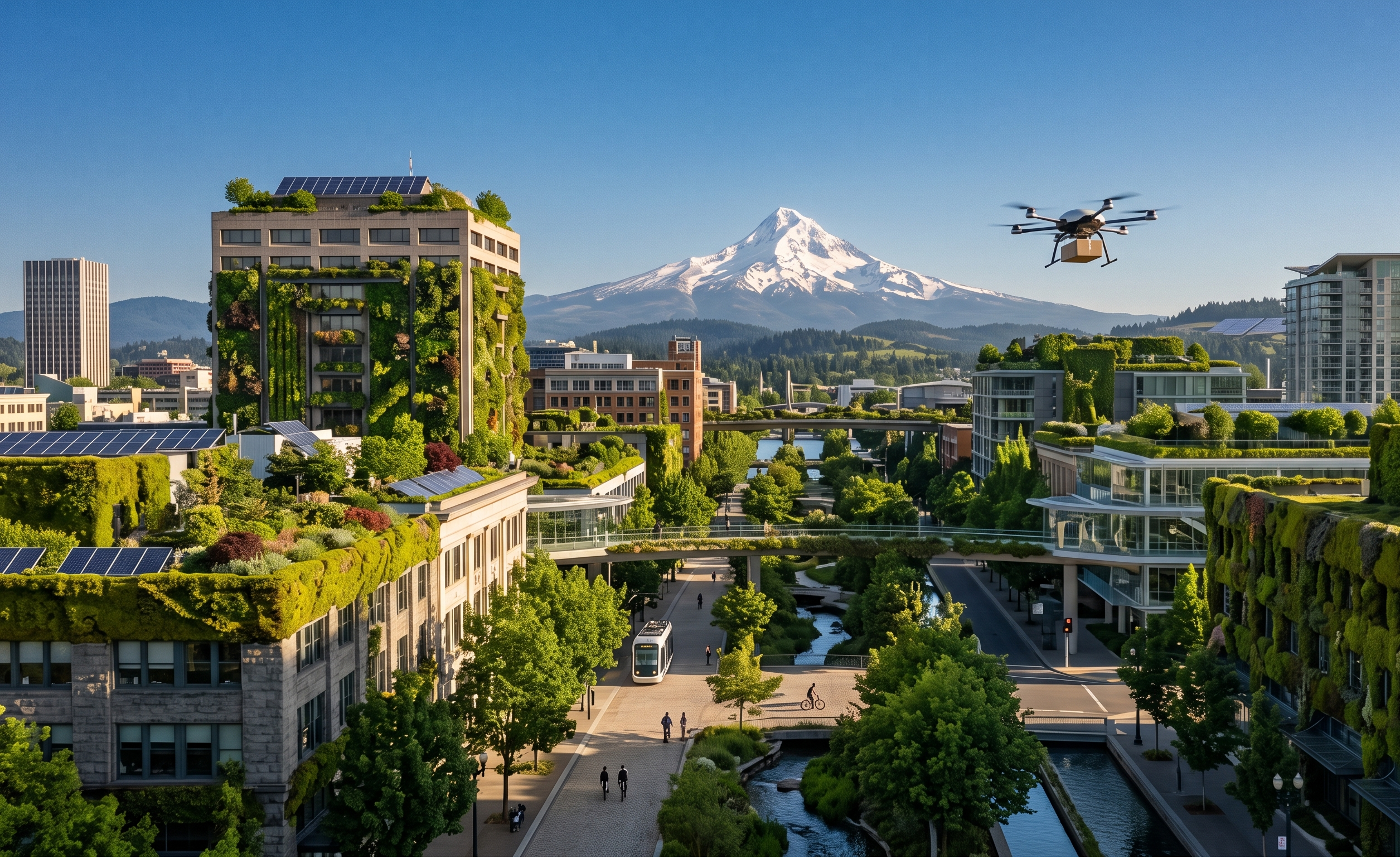
She stepped outside and Portland hit her the way it always did — not like a wall, not like noise, not like the hostile sensory assault that cities had spent most of human history delivering to the people who lived in them. It hit her like a good piece of music. Like something that knew what it was doing. Like something that had been practicing for a long time and had finally, in the last few years, started getting it right.
The air was the first thing.
Clean in a way that was still, three years in, not entirely ordinary to her. Not the sanitized blankness of filtered indoor air. Actually clean — the particular living quality of air that had been recently processed by ten thousand trees, a district full of photosynthetic building cladding, and a city that had spent four years methodically removing the things that made it bad and replacing them with things that made it good.
Air quality index: 11. She knew this because the apartment had told her. She would have known anyway — felt it in the first breath the way you felt the difference between tap water and cold mountain water. The number was almost insultingly good. The EPA threshold for "good" air quality was anything below 50. Portland hadn't been above 22 in fourteen months.
She stood on the front step and breathed it in and felt it the way she felt the mycelium wall. Like something alive was paying attention.
The street was quiet in the way Portland had been learning to be quiet for four years — not the quiet of emptiness or decline, but the quiet of a place that had methodically removed most of its reasons for noise. The internal combustion engine was almost gone from these streets. Sixty-seven percent of vehicles fully electric, another eighteen percent hybrid, all of them guided by FLOW — the city's AI traffic management system, a name so accurate it had stopped sounding like a name and started sounding like a description of what traffic could be if you stopped treating it as a necessary disaster and started treating it as a solvable problem.
FLOW had done something the transportation engineers of the previous century had believed was genuinely impossible: it had made a city move like a river. Every vehicle knowing the position and velocity of every other vehicle in real time, gaps opening and closing with the fluid unhurried logic of water finding its level. No stop-and-go. No eight-car backup because one person hesitated at a green. No idling. The system had reduced congestion by seventy-one percent and with it had eliminated the low-grade acoustic violence that Kira had grown up accepting as simply what cities sounded like — the roar that she had not known she was absorbing, constantly, until the day it stopped and she had stood on this same street and thought: oh. So that's what quiet feels like.
Alberta Street at 7:09 a.m. sounded like this: wind in the street trees. A delivery drone two blocks over, hum no louder than a bumblebee. A door opening down the block, the smell of coffee escaping, a warm voice inside saying something to someone.
That was all.
Result: stop-and-go congestion down 71% · idling eliminated in managed zones
Acoustic impact: average street-level noise reduced 34 decibels vs 2020 baseline
Energy saving: 2.1 million gallons of fuel equivalent per month · no longer burned sitting still
The buildings on Alberta wore a new skin. The older brick ones — the ones from the early twentieth century, the ones with good bones — had been retrofitted during the city's 2025 initiative with a photosynthetic film thinner than a coat of paint that turned their entire south-facing surface into a passive energy generator. No panels. No hardware. No visible difference at all unless you knew to look for the faint iridescence in direct sunlight — there and then not there, like a soap bubble catching light, real and then impossible.
The building Kira lived in generated more electricity than it consumed. So did forty-one percent of the buildings on this street. Portland's energy grid now ran a daily surplus of 340 megawatt-hours, exported to three neighboring counties. This had been news for about a week eighteen months ago and was now simply Tuesday. Or Thursday, as the case was.
Two blocks east the vertical farms rose on the old industrial corridor — six towers, fourteen stories each, their exteriors clad in photosynthetic growing panels that produced food and energy from the same surface simultaneously. In morning sun the cladding glowed gold-green, warm and alive. At night it caught the city's ambient light and threw it back softly — a living shimmer that Sabrina had stood on the Morrison Bridge watching at midnight, before the catastrophe with Callum, before the bridge-crying, and understood as some things could only be understood at midnight, slightly drunk, alone.
Portland deployment: 6,200 buildings · 2024–2026
Grid surplus: 340 MWh/day · exported to three counties
She passed the community fabrication hub on the corner of Alberta and 18th — already open, a young woman visible through the window at one of the form-printers, building something architectural in pale composite with the absorbed fluency of someone who had grown up with these tools the way previous generations had grown up with pencils. The object taking shape looked like a chair — or the essential idea of a chair, stripped of everything unnecessary, arriving at something more functional and more beautiful than anything a factory would make because it had been designed by this specific person for this specific purpose and printed once, for her, in forty minutes, for eleven dollars.
Kira watched through the window for a moment. The woman didn't look up. She was in it — the absorbed state of making something, the quality of attention that was its own reward entirely apart from what the thing turned out to be. Kira recognized it. It was the state she was in when she was writing something real. She kept walking.
Half a block further: the neural lace clinic, second floor of the corner building, its window displaying the simple logo — a fine silver line tracing the curve of a human skull — and a sign: consultations by appointment, walk-ins welcome Fridays.
Kira always looked at this window. She had never gone in.
The lace was a thin-film mesh worn against the scalp — no surgery, no implant — that created a low-energy interface between the brain's surface electrical activity and ambient digital systems. Practiced users communicated with devices by intent rather than touch. Composed messages by thinking them. Pulled information from the city's network the way you pulled a word from your own memory — not by reaching but by needing, and finding it already there. Thirty-four percent adoption in Portland. Growing at six percent per year.
Kira had written 8,000 words about why she didn't wear one. The argument was simple: she wanted the friction. The half-second between thinking something and finding it. Because in the reaching, she sometimes found something she hadn't known she was looking for. The lace removed the reaching. She wasn't ready to give up the finding.
She looked at the clinic window.
She kept walking.
Function: thought-to-device communication · intent-based navigation and information retrieval
Portland adoption: 34% · Global: 18% · growing 6% per year
On the corner of Alberta and 20th, mounted on the light pole at the height of a second-story window, a starling watched the intersection.
Not the bird. The node — matte white, the size of a folded newspaper, shaped like a pair of wings at rest. There was one on every major corner now, and had been for two years, and Kira registered it the way she registered the clean air and the quiet streets: as part of the same long exhale. The city, taking care of itself. The city, paying attention.
Real starlings, she knew from a piece she'd written years ago, almost never mean one bird. They mean murmurations — ten thousand birds wheeling over a winter field, turning together in the same instant, no leader, no signal anyone has ever found, a single enormous mind wearing ten thousand small bodies. One starling is a songbird. A flock of them is something else entirely — something that moves as one thing, sees as one thing. Whoever named the network probably just liked the wings. Probably.
She had written about the starlings once, in the network's first spring — a warm piece, and she'd meant every word of it. In its second month of operation, the Portland mesh had found a missing six-year-old in nine minutes. Nine. The girl had wandered from a birthday party toward the river, and the starlings had traced her small determined route corner by corner, and a patrol officer had picked her up two blocks from the water with her shoes in her hand. Kira had interviewed the mother. The mother had cried through the entire conversation and kept saying the same four words: nine minutes. Nine minutes.
Carjacking was functionally extinct inside the coverage zone. Hit-and-runs were solved in hours. Stolen cars came home before their owners finished the report.
Portland had voted the network in by ballot measure — sixty-eight percent yes, the highest turnout in city history.
Kira had voted yes. So had nearly everyone she loved.
The light changed. She crossed the street.
Results to date: missing-person recovery time down 91% · vehicle theft down 94% · hit-and-run clearance: 98%
Governance: operated under municipal contract · data policies set at adoption
The Alberta Farmers Market was set up along four blocks the way it had been every Thursday and Saturday for twenty years — heritage produce vendors who had been here from the start, and beside them the precision fermentation artisans selling cultured cheeses and lab-grown charcuterie that had never required an animal, and beside them the bioluminescent plant sellers and the mycelium material artists and the woman whose entire booth smelled of something warm and vegetal because she made functional clothing from agricultural waste fiber. Old and new, traditional and engineered, sitting side by side without apology or hierarchy. The market had simply expanded to hold all of it.
Rosa Delgado was sixty-three, had been selling eggs here for eleven years, and had the unhurried competence of someone who had long since stopped needing validation from anyone. She kept three chickens — Tolstoy, Eliot, and Brontë — in a converted backyard coop in Northeast Portland. The eggs came in a reused paper carton. Brown and cream, occasionally still warm. Two dollars each.
"Brontë's been difficult," Rosa said, handing over six without being asked.
Kira handed over twelve dollars. "What happened?"
"She's been sitting on eggs that aren't hers. Thinks she's a mother. She's not a mother. She's confused and extremely committed to being wrong."
Kira laughed. "That's the most Brontë thing I've ever heard."
Rosa looked at her with the expression of someone who had made peace with the personalities of her livestock. "Most of us are," she said simply.
On her way off, Kira nodded toward the starling on the pole across from the stall — new this spring, white wings folded against the grey sky. "At least the market's safer these days."
Rosa didn't look at it. She had the studied not-looking of someone who had decided about a thing a long time ago and saw no reason to keep deciding. "Chickens don't lay right when they're watched," she said. "Nothing does."
Kira laughed.
Rosa didn't.
She bagged the eggs and turned to the next customer, and Kira filed the moment where she filed most things — somewhere between charming and material for later — and moved on into the market.
She walked the market. Bought citrus from a vertical farm vendor — smaller and more intense than anything she'd grown up eating, the flavor concentrated by AI-optimized grow cycles. Stopped at a fermentation stall and tasted a cultured butter so clean and so deeply itself that she stood in the particular silence of someone experiencing something unexpectedly moving, then bought two jars without deliberating.
Between the citrus and the butter, her phone buzzed once. Her mother.
Did you get my message, sweetheart? No rush. It's been eleven days, so. No rush.
Kira stood in the middle of the most beautiful market in the most beautiful city on the healthiest earth in a century, and felt her whole body do the thing it did: a flush of guilt, a flare of intention — tonight, I'll answer it tonight, properly, with a phone call even — and then, smooth as the vacuum sliding back into its wall slot, the intention filed itself somewhere dark and comfortable and was gone. She typed Yes! Calling you tonight and deleted it, because it committed her to tonight. She typed Sorry, crazy week and deleted it, because it wasn't true and her mother would know. She put the phone back in her pocket without typing anything at all.
She was not proud of it. She did it anyway. She had a system, and the system had a flaw, and the flaw had a folder, and the folder was full.
The market smelled like bread. She kept walking.
She was heading back when she passed the man at the bioluminescent plant stall. Late twenties. He looked up as she passed with the involuntary quality of someone whose attention had been redirected without permission. He opened his mouth, closed it, looked back at the plants. Then, apparently against his judgment:
"I'm sorry — are those eyes real or a lens thing? Because I've been trying to work it out for thirty seconds and it's becoming a problem."
"Real," Kira said.
"Of course they are," he said, accepting a small defeat with dignity.
She smiled. Kept walking. Behind her, quietly: "Of course they are."
Three men in one morning. Joel at the door. Dex at 7:04. And now this one, defeated by the simple fact of her eyes at a plant stall. She filed all three where she filed the clean air and the quiet streets — present, unremarkable, requiring nothing from her.
She stood at the corner of Alberta and 22nd with her canvas bag — eggs, citrus, two jars of butter — and looked east toward the farms. Morning light fully up, March sun low and gold, the tower cladding doing the thing it did in direct light: that barely-there iridescence, real and then impossible, there and then not there.
The farms cleaning the air. The street trees pulling carbon from the sky. The living buildings knitting themselves back together in the dark. The bioluminescent plants glowing through the night so no one had to turn on a light. The drones crossing oceans. The robots making coffee. All of it working simultaneously, continuously, without complaint or drama or anyone needing to think about it.
The world, humming along.
The world, having been persuaded — slowly, expensively, by people who cared enough to keep arguing past the point where arguing felt useful — to take care of itself.
She thought: if someone from 2008 could stand on this corner right now, breathing this air, watching this city — they would not recognize it. They would think they had taken a wrong turn into someone else's future.
She thought: this is my future. This one. The good one.
She thought: Sabrina is alive and coming over and I have real eggs and it is Thursday morning and the mountain is out.
Her jacket pocket pulsed once — the apartment, detecting she was two blocks from home, sending its quiet single vibration. Its way of saying: when you're ready.
She was ready. She turned toward home.
Above the rooftops, Mt. Hood was still out — white and enormous against the cleaned blue sky, visible the way it hadn't been on most mornings for most of the previous two decades. The mountain had always been there. The city had simply learned to stop standing in front of it.
She looked at it for a long moment. The way she looked at things she did not want to forget.
Archive item: Cascade Institute · Dr. E. Raines · Applied Temporal Physics · filed: Flattery
Sender: CONFIRMED AUTHENTIC · UW faculty directory · peer-reviewed 2027
Personal address score: 97.8 / 100 · written for Kira Monarch specifically
Prior reclassifications this year: 4 · accuracy: 100%
→ RECLASSIFYING: Priority HIGH
→ Occupant: 2 blocks from home · ETA 4 minutes · notification queued for arrival
She didn't see this.
She was looking at the mountain.
Four minutes from the door. Four minutes from the rest of her life.
The mountain didn't know. The clean air didn't know. The eggs still warm in the canvas bag didn't know.
Only the apartment knew. And it was waiting — with the patient faith of something that had learned, over two years, that the right information at exactly the right moment was worth more than any amount of noise.
In four minutes she would walk through her front door. In four minutes and thirty seconds, it would speak. And the morning that had been the most beautiful ordinary morning of her life would become the last ordinary morning she would ever have.
She walked home through the city she loved. The clean air, the quiet streets, the mountain above the rooftops, the eggs still warm through the canvas bag. She was happy. Completely, simply, specifically happy. She would spend a long time, later, trying to find her way back to this corner. This light. This exact quality of not yet knowing.
Continue · Part IV of IV · The Callwritten, revised, and built together.