Ninety-Seven
Years
March 14, 2028 · Portland, Oregon · 7:35 a.m.
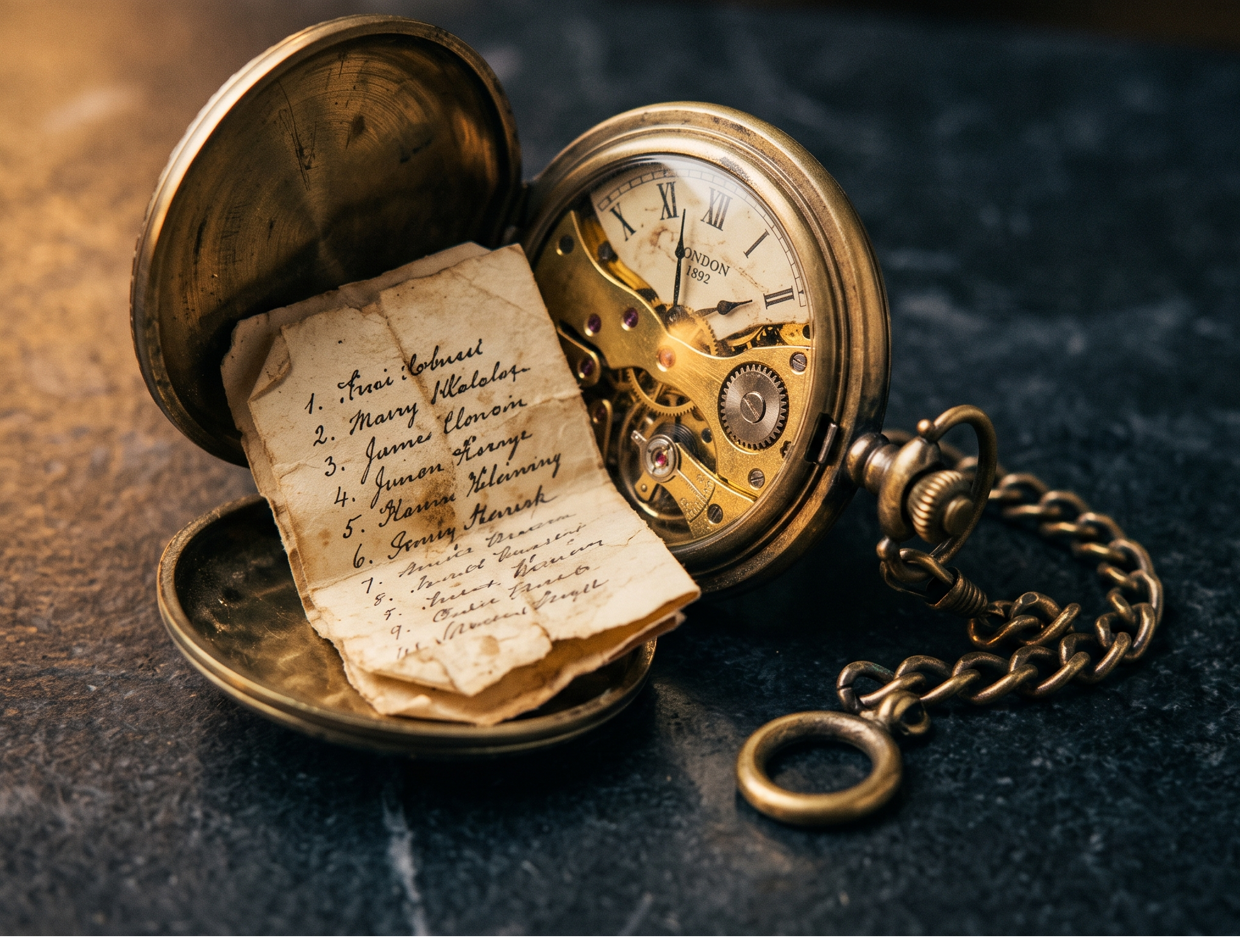
She came through the door at 7:35, canvas bag over her shoulder, eggs and citrus and two jars of cultured butter, the cool clean air of the street still on her jacket, the mountain still behind her eyes the way a good view stays with you for a few minutes after you stop looking at it. She set the bag on the counter. The robot was there, already reaching for the eggs to put them away, and for one more second — one more ordinary, perfect, forgettable second — everything was exactly what it had been all morning.
Then the apartment said her name.
Not the ambient voice. Not the this-can-wait voice.
The other one.
"Kira."
She stopped with one hand still on the counter.
"There's something in your archive I think you should look at now. I've held it since 6:49 this morning while I built confidence in the source. I'm confident now. Ninety-seven point eight out of a hundred. I don't think I've ever been this confident about anything in your archive before."
Kira didn't move for a moment.
In two years, the apartment had used this voice exactly four times. Once when her mother had a fall and the building's network caught the emergency alert minutes before her phone would have. Once for a gas leak two buildings over. Twice for small course-corrections she still didn't fully understand — things that had turned out, later, to matter more than she'd realized at the time.
Four times. A hundred percent accuracy.
She set down the canvas bag. "Show me," she said.
The display surface on the kitchen wall — the one that usually showed the weather, or the time, or nothing at all, just warm wood grain pretending to be wood — brightened. The notification she had swiped away nearly fifty minutes ago opened itself fully for the first time.
Ms. Monarch — I know this will sound impossible, and I know the subject line of this message has likely caused you to dismiss it already. I'm asking you, just this once, to give me four sentences before you do.
Two weeks ago, a research team at this institute successfully sent an object one hundred years forward in time and recovered it intact. The object was a pocket watch. It came back.
We believe, based on a comprehensive personal and professional profile assembled over the past six months, that you are the single best-suited person in North America to be the first human participant in the next phase of this research.
If you read nothing else today, please call the number below. We are not the only ones who know this technology exists, and we believe the window in which this choice still belongs to you is closing.
Kira read it once.
She read it again.
She did not move.
Four sentences. Ninety-seven years of patience, and it came down to four sentences — and the fourth one was not what she had expected at all.
"The first part checks out," the apartment said, quietly, into the silence. "Cascade Institute filed a classified materials-recovery patent eleven days ago. The filing itself is sealed, but its existence is public record, and the date is consistent with this message. I cross-referenced the named researcher. Dr. Elliot Raines is real. Tenured. Published. His most recent paper — peer-reviewed, 2027 — was on anomalous spacetime folding at quantum scale. I read it. I didn't understand most of it. I understood enough."
Kira found her voice. It came out smaller than she expected. "And the last sentence?"
"I can't verify that one," the apartment said. "I can't confirm anyone else knows. I can't confirm a closing window. That sentence is either the most important one anyone has ever sent you — or it's a persuasion technique. And if it's the second thing, it's working, because you're still standing there."
"That's not comforting."
"I know. I'm sorry. I gave you everything I have."
Kira looked at the message again. At the watch. At it came back, sitting there in the middle of the second sentence with the quiet weight of something that should have been impossible and apparently, according to a tenured physicist with a peer-reviewed publication history, was not.
She thought about the city she'd just walked through. The clean air. The mountain. The vertical farms glowing gold-green. Sabrina, alive, on her way over with a story about a bar and a bridge and being glad to be alive.
She thought: one hundred years from now, all of this is still here. Or it isn't. And somebody already knows which.
Occupant: kitchen · stationary · biometrics elevated · heart rate +22 from baseline
Notification: read · re-read · not archived · not dismissed
Home unit: standing by · awaiting instruction
→ I don't know what happens next. I have never not known what happens next.
The phone rang.
Kira's whole body went still in the specific way bodies go still when something happens at exactly the moment it shouldn't be possible for it to happen — when the universe stops pretending the timing is a coincidence.
She had not called the number in the message.
She had not told anyone she had read it.
The apartment had opened the notification ninety seconds ago.
The phone was ringing.
She looked at the screen. Unknown Caller. Seattle, WA. Ninety-seven years of patience, and whoever was on the other end of this call had apparently decided that patience, as a strategy, had just run out.
She answered it.
Outside, the mountain was still out. The eggs were still on the counter, going warm. Somewhere across town, Sabrina was almost at the door, carrying a story about a bar and a bridge and a man with a jawline, completely unaware that the morning she was walking toward no longer existed.
She had woken up in the most beautiful version of the world that had ever existed. A robot had made her coffee. A drone had crossed an ocean while she slept. She had walked through clean air under a visible mountain, bought eggs from a woman whose chickens had names, and listened to her best friend cry on a bridge from gratitude at simply being alive. And now a man in Seattle was telling her that a piece of paper had traveled one hundred years through time to arrive with her name already written on it — first on a list of seventeen, in handwriting no one could identify, placed there before she had said a single word.
written, revised, and built together.